Two modular products, two configuration logics
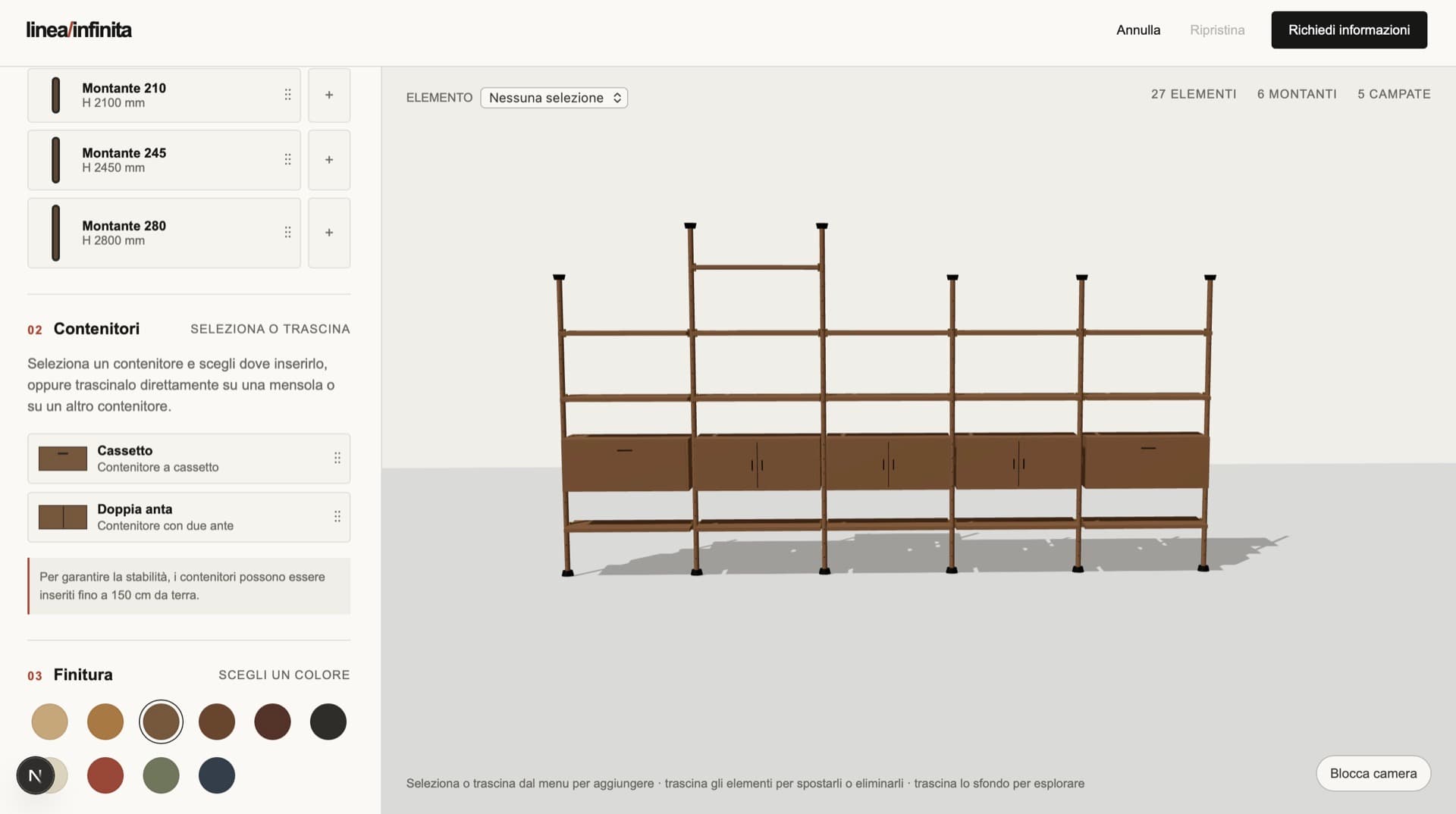
Modular shelving configurator demo
The Modular shelving system demo is designed for systems built around a load-bearing structure. Uprights, shelves and storage units depend on one another: the configurator calculates valid positions and immediately displays the composition constraints, managing supports, heights and bays.
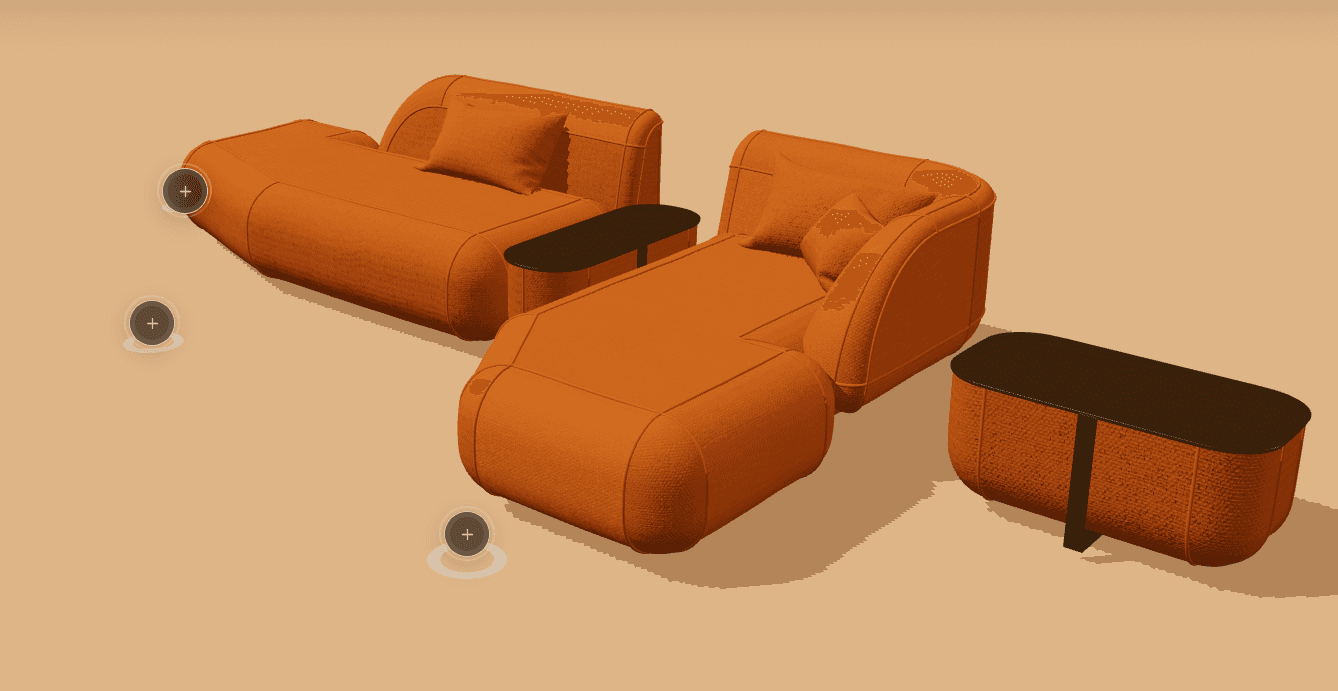
Modular sofa configurator demo
The Modular sofa demo applies the same principle to a lounge system, where seats, tables and accessories can only be combined in positions compatible with the elements already present. Upholstered elements and complementary pieces are treated as related rather than independent objects.
Compatibility and guided positioning in the 3D scene
The configurator validates constraints before positioning and offers only the available alternatives. The rule engine filters the catalogue according to what is already in the composition, applying progressive disclosure logic: users do not need to know the product's technical rules or proceed by trial and error. They select an element and see the anchor points where it can be added directly in the 3D scene.
This approach makes even complex configurations easy to understand and prevents compositions that cannot be manufactured. Interaction takes place through selection, click or tap, and drag & drop, adapting to the product and device: the demos work in the browser on both desktop and mobile.
Automatic reconciliation: a composition that always remains consistent
Adding, replacing or removing a module can affect the validity of connected elements. For this reason, the configurator does not treat each object as independent: it applies reconciliation logic and automatically updates the composition when a change involves multiple products.
Operations remain undoable and redoable as single actions, even when a modification includes more than one change: a movement that triggers three automatic replacements is undone in a single step, without going back through the intermediate states.
Shared variants, such as a finish applied to the entire composition, are updated with a single command while keeping all the product codes involved aligned.
From the configurator to quotations and business systems
A 3D configurator connects the visual composition to commercial and production data. Prices and quotations are recalculated based on the products present and the current price list, and each configuration can be saved or shared.
In projects developed by PARAMETRA, the flow continues with PDF quotations, a bill of materials (BOM), CSV or JSON exports, CAD outputs in DXF, STEP and other exchange formats, and integrations with product catalogues, e-commerce platforms, CRM and ERP systems. Architecture, rules and exports are defined according to the specific needs of the product and sales process.
Applications of 3D configurators for modular furniture
The same approach applies to many families of modular products:
- bookcases, shelving and upright systems
- sofas, seating and modular lounge systems
- wardrobes, walk-in wardrobes and fitted wall systems
- modular kitchens and bathroom furniture
- office, retail and display furniture
- technical and industrial furniture
The common denominator is the need to transform compatibility, dependencies and catalogue variants into an intuitive configuration process, while keeping every composition commercially and physically valid.