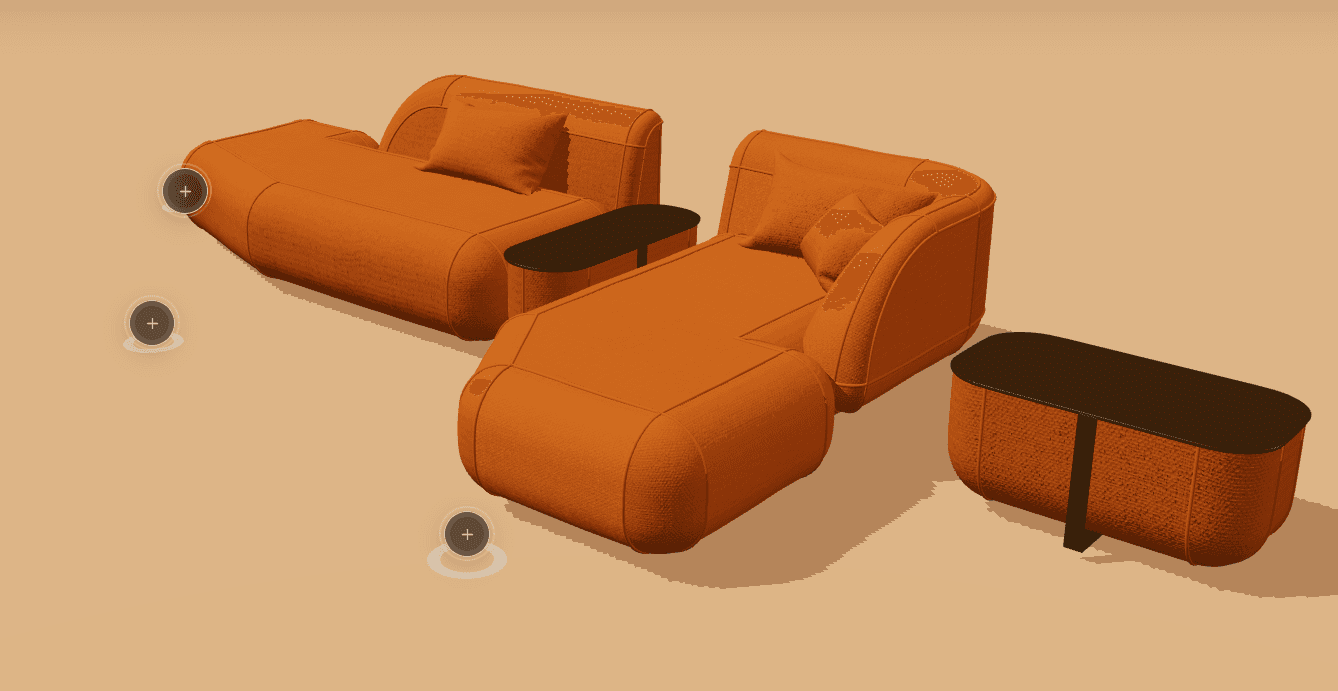
Compatibility engine: free-form compositions within defined relationships
A modular sofa offers a high degree of compositional freedom, but that freedom is not unlimited. The compatibility engine governs the relationships between elements:
- linear and corner seating modules connect only along compatible sides
- side tables are not freely positioned in space: the system calculates permitted positions between modules, at the ends and around the composition
- decorative cushions are an option for each individual sofa, not a global choice
Valid positions appear in the scene as soon as an element is selected for insertion. This advance validation makes it impossible to build an unfeasible configuration while guiding the composition: the rule is not explained, it is made visible.
Reconciliation: the composition always remains consistent
What happens when a module is removed from the centre of a composition? The configurator must display a valid product at all times, so removal never leaves a gap: adjacent elements compact together and close the freed space.
When removal creates cascading effects—for example, because a side table occupies a position that exists only due to the module being removed—the system warns the user before proceeding and makes the consequence explicit instead of applying it silently.
Every operation is atomic and includes the reconciliations it triggered: undoing it restores the entire composition to its previous state, reconciliations included.
Colour variants: free combinations propagated across the entire composition
Colour in upholstered furniture is not a single finish. Fabric and piping are two separate variables that the customer chooses in combination, while the metal of the side-table tops is a third variable that must work with both.
In the demo, the 6 colours can be applied independently to fabric and piping and freely combined, producing 36 possible pairings, multiplied by the 3 metal finishes available for the side tables. A colour change affects the entire composition: every seating module, cushion and side table updates in a single operation, regardless of how many elements the scene contains.
From a commercial perspective, a variant of this kind replaces the product code (SKU) of every element at every level of the hierarchy, keeping the bill of materials consistent with what appears on screen.
The scene background follows the colour selection using pastel tones inspired by still-life photography. This is not merely an aesthetic detail: colour perception depends on its surroundings, and using the same neutral background for every variant would distort the comparison between a pale and a saturated fabric. The reactive background presents each combination under the same viewing conditions in which it would be photographed for a catalogue.
A minimal interface that guides the user
The interface is minimal and concentrated in a central dock. Input controls do not accumulate in side panels: they replace one another in the same area according to what the user is doing, showing only the choice relevant to the current step.
Reduction is also a positioning choice. In the high-end furniture market, an interface crowded with controls communicates a technical tool, while a configurator that keeps the product at the centre of the scene communicates the value of the product. The consistency between the clean interface and the clean design of the configured object is part of the commercial message.
In-scene annotations are anchored to the elements they refer to rather than collected in a legend. The call to action remains visible at all times, regardless of the configuration state.
The same interactions are adapted for touch on mobile devices and tablets and can be replicated from the keyboard to comply with accessibility regulations.
Quotation, exports and integrations
This demo focuses on configuration and the visual presentation of the composition. In the configurators PARAMETRA develops and integrates into its clients' business processes, that same configuration becomes the starting point for quotations, bills of materials and data transfer.
In those systems, price is not stored in the configuration: after every change, the quotation is recalculated from the product codes in the composition and the current price list. Price lists, discounts and catalogue versions can therefore be updated without changing configurations that have already been saved or shared, which remain readable and can be recalculated using current prices.
A modular upholstered-furniture configuration can be used to generate:
- a PDF quotation with a render of the composition, module list and line-item prices
- a bill of materials structured by module, with fabric, piping and metal finishes declared as variants
- CSV and JSON files for import into ERP and management systems
- production sheets for cutting and sewing the upholstery
- fabric requirements for each order, where consumption depends on the configured combination of modules
The configurator can also be integrated with existing business systems:
- CRM and ERP systems when a configuration is confirmed
- the company product catalogue, which remains the single source of truth for codes, dimensions and variants
- e-commerce platforms and existing websites
- restricted access with SSO for salespeople, dealers and designers, with price lists differentiated by profile
Applications: modular products based on adjacency
A configurator of this kind can be applied in several areas: the common denominator is not the sector but the product structure, made up of self-supporting modules that can be freely placed together within adjacency and variant rules.
- Modular sofas and seating systems, where the composition changes for every customer and upholstery consistency is shared across all modules
- Contract and hospitality seating, configured for lobbies, waiting rooms and communal spaces from a fixed catalogue of modules
- Armchairs, poufs and matching accessories, sold in colour combinations with the main seating
- Upholstered beds and modular headboards, with fabrics, piping and finishes shared with the rest of the collection
- Modular outdoor furniture, where the same adjacency rules govern compositions for terraces and outdoor spaces
- Seating for offices and workplaces, with linear and corner modules combined into islands and informal areas
- Benches and seating for public spaces, configured to fit each layout from standard elements
The common theme is managing variants across free-form compositions: fabrics, piping and metal finishes that must remain consistent across a changing number of elements, with pricing and a bill of materials that follow the composition without being rebuilt manually.
Credits
Design inspiration and 3D models: RAFT Sofa by Donna Furniture.